
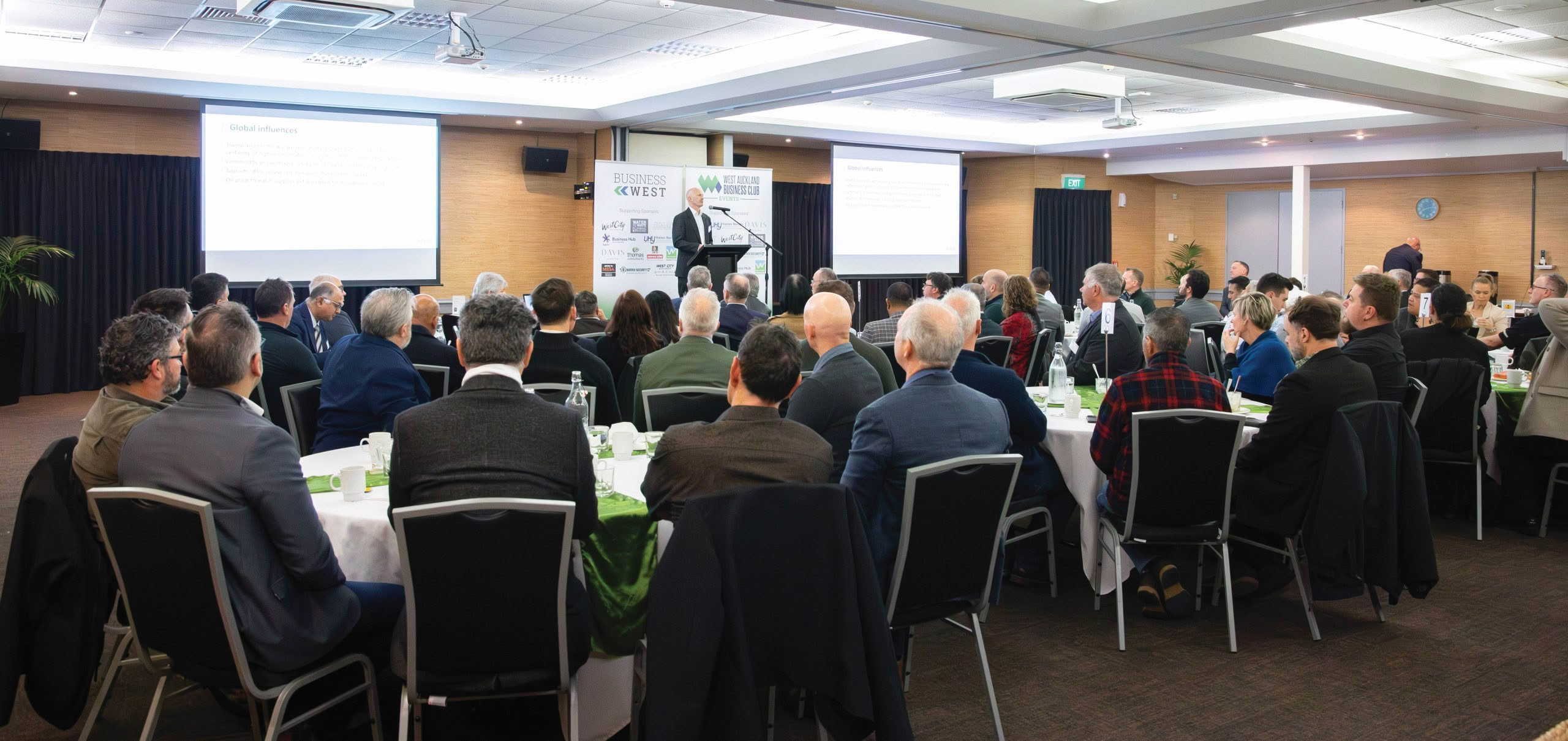
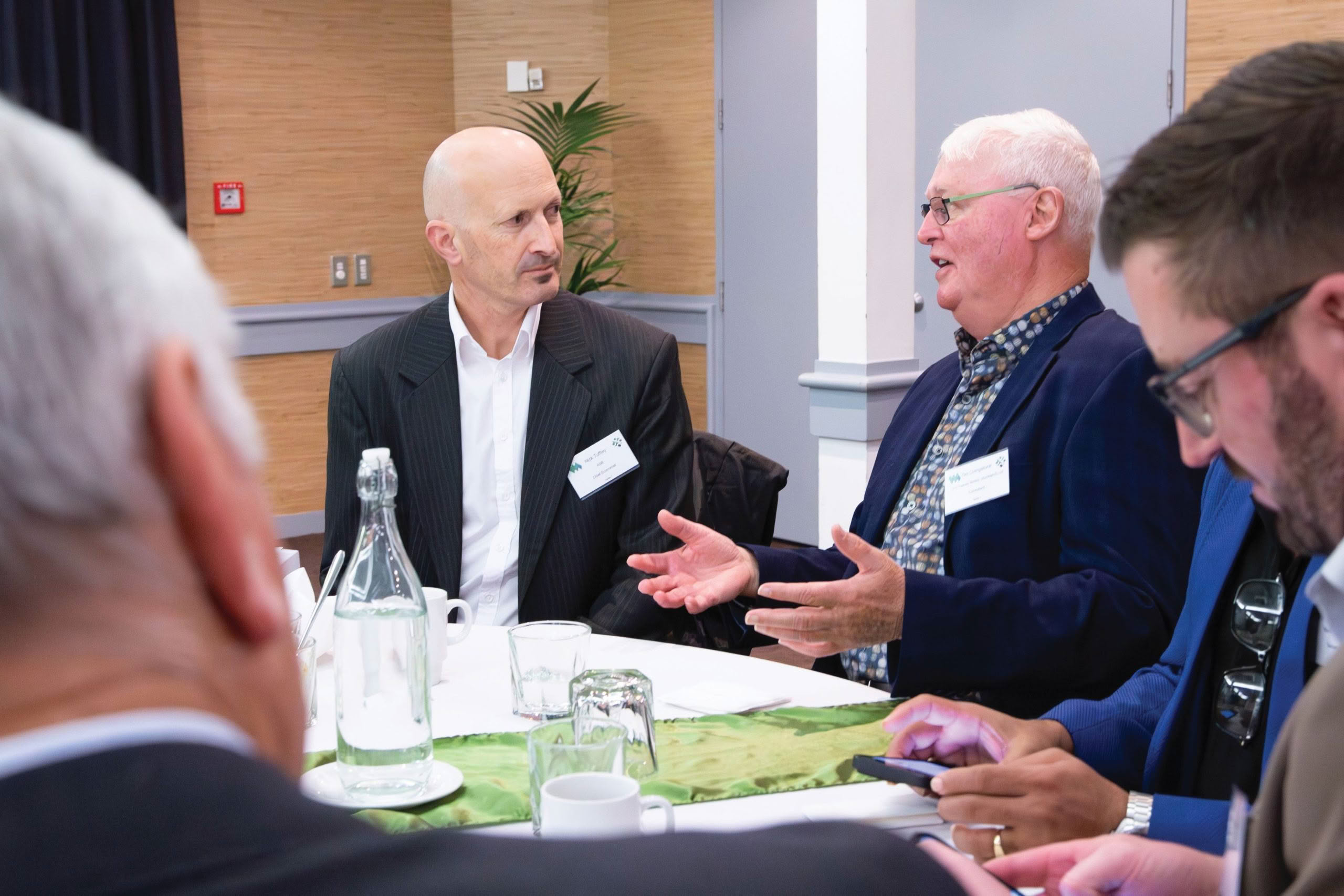
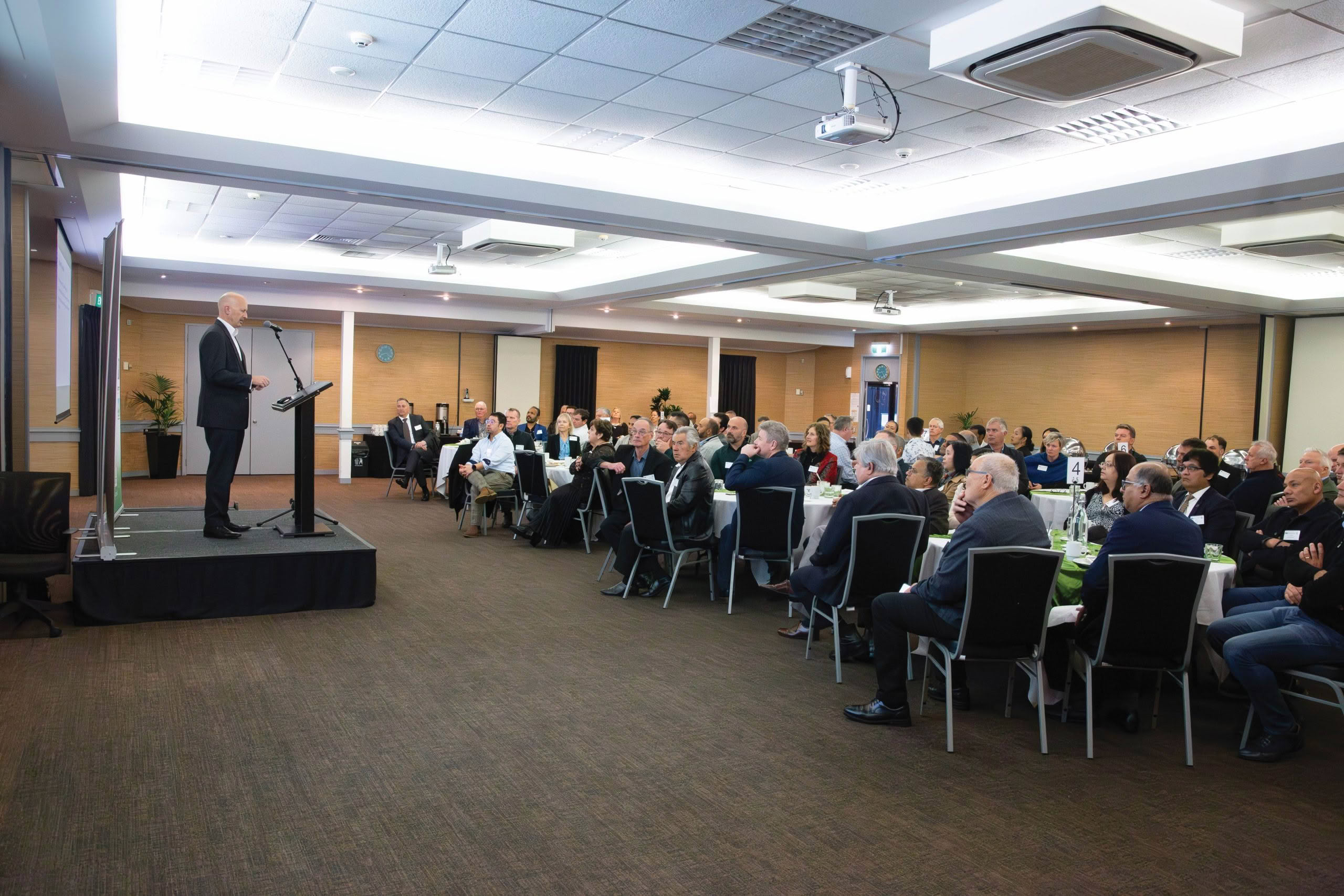
As the Chief Economist at ASB – one of the country’s biggest mortgage lenders, Nick Tuffley has an inside perspective on interest rates. He is also known for his ability to simplify complex concepts and for making economics engaging.
And that’s exactly what attendees at our Business Breakfast in July got to enjoy. Both insightful and entertaining, Tuffley gave us his assessment of interest rates and the economy, proclaiming that ‘If it’s not fixed in ’26, hopefully, it’ll be heaven in ’27!’
Tuffley’s verdict on the economy:
‘If it’s not fixed in ’26, hopefully, it’ll be heaven in ’27!’

Trump’s trade tariffs
Tuffley began his presentation by discussing Donald Trump, whom he referred to as ‘outrage entertainment’. Trump’s trade tariffs are the big global story at the moment, and it’s also a fast-changing situation. Tuffley was speaking before Trump’s surprise move to increase NZ tariffs to 15% and his comments are based on the original 10%.
‘We’ve all seen the cap – make America great again – and Trump’s vision for doing that is to put lots of tariffs on goods going into the US,’ advised Tuffley. He stated that Trump wants to create jobs in the US by encouraging businesses to establish manufacturing plants. And he plans to use the additional revenue raised to fund tax cuts.
According to Tuffley, the likely result of Trump’s tariffs is a slowdown of the US economy. ‘If you’re putting tariffs on goods and services coming into the country, it raises the cost domestically, and if you’re paying more for stuff and haven’t managed to get a tax break, your money’s not going as far,’ he warned. This could lead to a decrease in consumer spending and a potential economic slowdown in the US, which would have ripple effects on the global economy.
Another implication of Trump’s tariffs is the impact on the countries to which NZ exports. ‘If, for example, China suddenly sees its economy slowing because it’s facing big tariffs, we need to start thinking about what that means for the demand from China for our products,’ Tuffley advised. A slowdown in the Chinese economy could lead to a decrease in demand for NZ’s products. There may also be some price impacts for consumers buying products made in the US, as they’re likely to be more expensive.
On the plus side, Tuffley says, countries like Europe and China, if they are not exporting as much to the US, may start shipping more goods here at better prices. This could be a silver lining from an inflationary perspective, potentially offering consumers better deals. However, it could pose some challenges for local manufacturers if they are competing against cheaper imports.
Overall, Tuffley says that unless you operate in an industry directly impacted by the tariffs, and here he listed dairy, wine and meat as the most exposed sectors, then the effect of the tariffs is likely to be minimal. ‘All up, the impact on NZ’s $9 billion trade with the US is around $900 million in tariffs: not helpful but still manageable,’ he declared.
Interest rates and inflation
Tuffley turned his attention closer to home and said that people want to know about what’s happening with interest rates and mortgages.
He explained that the Reserve Bank’s job is to keep inflation between 1 and 3% over the medium term. Tuffley said that we may see inflation bouncing around a bit this year, noting the increase in food prices, with the cost of butter being a current hot topic. While the high price of butter is not good news for any bakers out there, on the flip side, NZ is the world’s largest dairy exporter.
One of the primary drivers of inflation, according to the Chief Economist, has been wage growth. ‘That baked in a lot of cost, especially in the service sector,’ he said. Thanks to rising unemployment, much of that growth has now slowed, and there’s also been a reduction in hiring, which combined is helping to keep inflation down.
When it comes to interest rates, Tuffley says that the Reserve Bank will be keeping a close eye on Trump’s tariffs and the impacts on exports. ‘There’ll be a lot of nervousness in the short term,’ he advised as the effects on inflation, wages, consumer prices, and spending become clearer. However, he predicted that the Reserve Bank would make one more cut to the cash rate this year and that it’s likely to settle around the 3% mark.
Overall economy
Overall, Tuffley was reasonably confident about the economic outlook. ‘The good news is the economy has already started to lift back up, helped by the export sector and an increase in consumer spending,’ he declared. Last year was pretty tough, Tuffley said, and many consumers put their wallets away. ‘We’re starting to see some early signs that consumers have found their wallets and are starting to blow the dust off.’
According to the Chief Economist, house prices have stopped falling and are slowly creeping up. He added that construction has been under a lot of pressure over the past two years, with residential building down by one-third. However, building activity is also starting to pick up and more consents are being issued.
Tuffley highlighted the government’s investment boost policy, aimed at increasing business investment and productivity. ‘This is well worth looking into as an upfront depreciation expense you can push through to improve your cashflows when buying new assets,’ he declared, adding that the policy should lift productivity and investment spending.
Tuffley ended his presentation on a positive note: ‘Hang in there, things will get better,’ he advised. Let’s hope Trump’s 15% tariff rate doesn’t throw a spanner in the works.